Permits, Setbacks & Zoning in Cass and Clay Counties | Who Issues What, and Where the Ag Exemption Ends
Two states, two counties, dozens of townships and cities. Here is who actually decides what, and where people most often get it wrong. Two states, two counties and dozens of townships, with the most common mistake being to assume that exemption from one thing means exemption from the other.
Get a quote on your building
Tell us the size, the use and where the site is. We will come back with a scope and a price, not a brochure.
The single most common mistake
Zoning approval and building approval are two different things, and being exempt from one does not exempt you from the other.
Zoning determines whether a building of that type, size and position is permitted on that parcel. It covers setbacks from property lines and roads, watercourse setbacks, floodplain requirements, accessory building size limits and land use. The building code determines whether the design and construction meet safety and structural standards.
An agricultural building in North Dakota can be entirely exempt from the state building code and still be fully subject to township setbacks, watercourse setbacks and floodplain rules. People discover this after the building is up rather more often than they should.
Who permits what in Cass County, North Dakota
North Dakota is a home rule state with a mandatory statewide minimum. The North Dakota State Building Code sets a floor that no local jurisdiction can go below. Cities with a population over 2,500 are required to employ a building official and enforce it. Smaller cities and counties may opt in.
In practice, in Cass County, that produces three situations. Inside an incorporated city such as Fargo, West Fargo, Casselton or Horace, the city permits and inspects. Within a city's extraterritorial area, the city generally still has jurisdiction over zoning. In unincorporated Cass County, the township zoning ordinance controls setbacks, land use and local permit rules.
Cass County Planning supports the townships, maintains the township resources, and handles floodplain administration for cities and townships that do not participate in the National Flood Insurance Program. If you do not know which township you are in or what its ordinance says, Cass County Planning is where to start.
Township ordinances are real documents with real requirements. They commonly cover conditional use permits, road and highway access, watercourse setbacks with minimal and limited disturbance zones, and building permits for new construction, additions, remodelling and structural alteration.
The agricultural exemption, stated precisely
NDCC 54-21.3-03 exempts buildings used exclusively for agricultural purposes on a farm or ranch from the North Dakota State Building Code. That is the whole exemption, and every word of it matters.
'Exclusively' means exactly that. A shed that stores your own equipment is agricultural. The same shed with half of it rented out for boat storage is not. 'Agricultural purposes' does not include living space, and a building containing a dwelling is not exempt, regardless of how much of the floor area is shop.
The exemption also does not extend to electrical work. The North Dakota State Electrical Board licenses electricians and enforces the National Electrical Code, currently the 2023 edition, across the entire state. That applies in townships with no building inspector and on buildings that are otherwise fully exempt. This one catches people out regularly on farm buildings.
Nor does it extend to the State Fire Marshal, who conducts plan review and inspection for a defined list of occupancies statewide.
Crossing the river: Clay County, Minnesota
Minnesota operates a mandatory statewide building code that every municipality enforces. There is no equivalent of a North Dakota township with no building official. The incorporated cities of Clay County manage their own zoning and permitting; rural areas go through the Clay County Planning Office.
Clay County's zoning structure is simple enough to summarise. Over 90 percent of the county is zoned Agricultural General. Agricultural Service Center districts cover small unincorporated communities including Averill, Baker, Downer, Kragnes, Rollag and Rustad. There are Highway Commercial and Limited Highway Commercial districts. And Urban Expansion Districts, Tiers 1 and 2, extend approximately two miles around Moorhead and Dilworth.
Lakes, rivers and streams carry Shoreland zoning, which applies within 1,000 feet of a lake or 300 feet of a river or stream. Shoreland brings lot size standards, ordinary high water level setbacks, impervious surface coverage limits, shore impact zone rules and vegetative clearing standards. On a county with as much water frontage as Clay, this affects more parcels than people expect.
Clay County requirements people miss
A Land Alteration Permit is required from the county Planning and Zoning Office for moving more than 50 cubic yards of material outside steep slopes and shore-impact zones, for more than 10 cubic yards within those zones, and for grading or filling certain wetland types. Building a raised pad on a flat site can exceed 50 cubic yards without anyone thinking about it.
Where a building is near a well, a minimum three-foot horizontal separation is required between the farthest exterior projection of the building and the well. On rural parcels with an existing well in an inconvenient place, this constrains siting more often than you would expect.
Septic certification is required where a building permit applicant is in the Shoreland district, or where an addition includes bedrooms. And within a flood plain zone, the proposed use must be elevated on fill or floodproofed to the regulatory flood protection elevation, which on bottomland parcels determines how much fill goes under the building.
In the Agricultural Service Center district, a private garage or storage building cannot exceed 5 percent of the total lot size, with right-of-way and setbacks excluded from the calculation. That is a genuine constraint on a smaller lot.
Feedlots are regulated separately
If you are building for livestock, be aware that animal feeding operations are regulated through a different system from your building permit. In Minnesota that runs through the MPCA framework with Clay County operating a County Feedlot Officer, and manure management plan requirements apply above certain thresholds. In North Dakota, townships can adopt Concentrated Animal Feeding Operation zoning language registered with the state.
Getting a building permit approved does not register the operation, and the two processes have different thresholds and different timelines. Both need attention before you commit to a site.
A practical sequence
Establish the jurisdiction first. City, extraterritorial area, township, or rural county. This is not always obvious from the road and it determines everything else.
Check zoning before design. Setbacks, accessory building limits, watercourse and shoreland provisions, and whether a dwelling is permitted if that is what you are building.
Establish the floodplain position. Through the city, the county, or Cass County Planning for jurisdictions outside the NFIP.
Then design, then permit. Designing first and checking afterwards is how buildings end up in the wrong place, and moving a post-frame building after the columns are set is not a realistic option.
Questions on this topic
Do I need a permit for an agricultural pole barn in North Dakota?
Buildings used exclusively for agricultural purposes on a farm or ranch are exempt from the North Dakota State Building Code under NDCC 54-21.3-03. That exemption does not cover zoning: township setbacks, watercourse setbacks and floodplain rules still apply. It also does not cover electrical work, which is regulated statewide.
Who issues my building permit in rural Cass County?
In unincorporated Cass County the township zoning ordinance controls, and building permits are handled at that level. Cass County Planning supports the townships and handles floodplain administration for jurisdictions outside the National Flood Insurance Program. Inside a city, the city permits and inspects.
What is different about permitting in Clay County, Minnesota?
Minnesota has a mandatory statewide building code that every municipality enforces, with no local opt-out. Incorporated cities manage their own permitting; rural areas go through the Clay County Planning Office. Over 90 percent of the county is zoned Agricultural General.
What is a Land Alteration Permit and do I need one?
It is a Clay County permit required for moving more than 50 cubic yards of material outside steep slopes and shore-impact zones, more than 10 cubic yards within them, and for grading or filling certain wetlands. Building a raised pad can exceed the threshold, so it is worth checking before moving material.
Does the agricultural exemption cover electrical work?
No. The North Dakota State Electrical Board licenses electricians and enforces the National Electrical Code statewide, currently the 2023 edition. That applies even in townships with no building inspector and on buildings otherwise exempt from the building code.
Can I build a barndominium under an agricultural permit?
No. Living space is not an agricultural purpose, and a building containing a dwelling is not exempt under NDCC 54-21.3-03 regardless of how much of it is shop. It has to be designed and permitted as a residence, with the egress, insulation, fire separation and energy requirements that brings.
Which code edition will my building actually be reviewed against?
It depends on the jurisdiction, and the answer has moved recently. North Dakota's statewide base is the 2021 I-code family, but Fargo has adopted the 2024 International Building Code with local amendments and West Fargo has adopted both the 2024 IBC and the 2024 IRC. Electrical is separate again, running on the 2023 National Electrical Code statewide since 1 July 2024.
Other guides
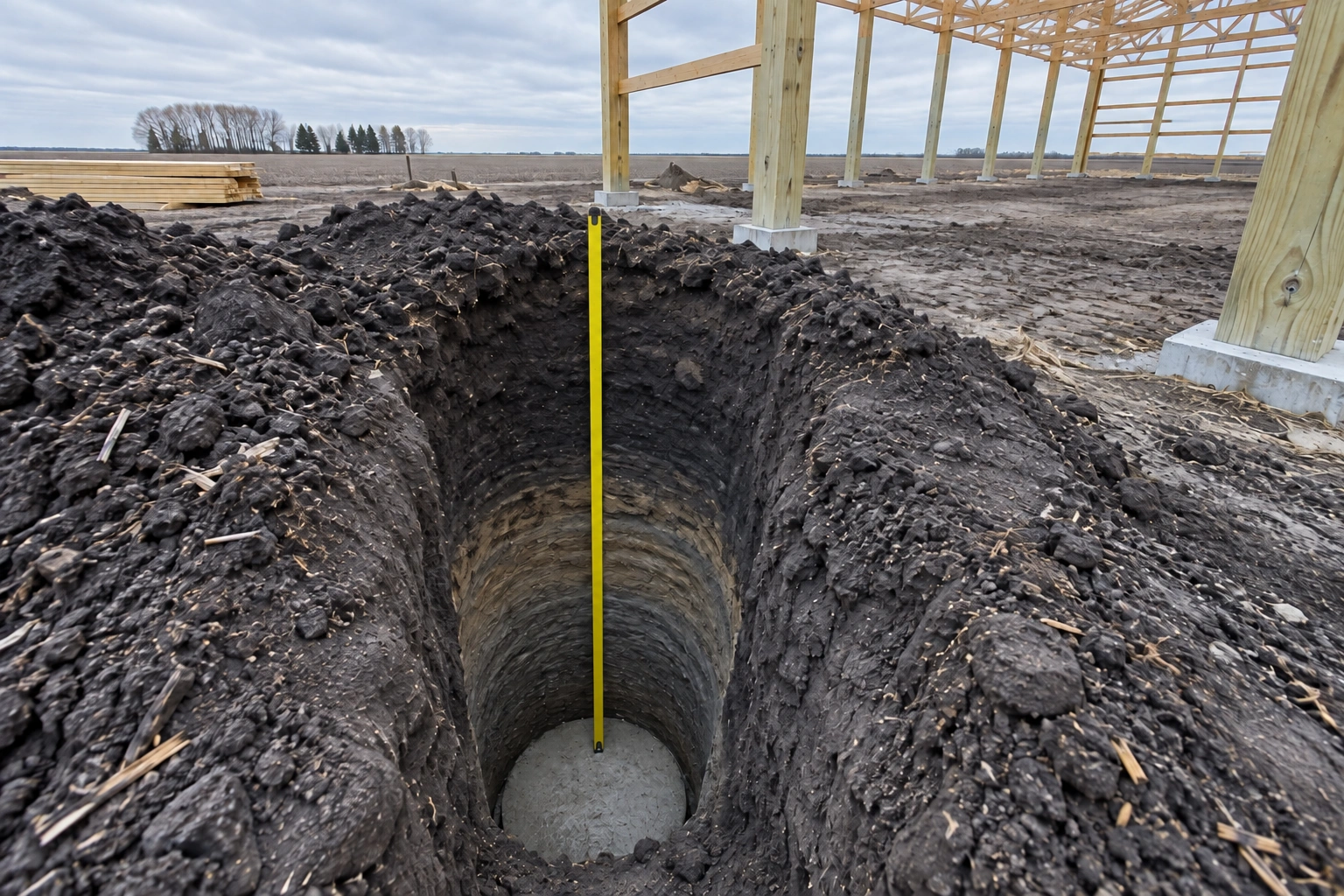 Frost Depth & Footing Design in Cass and Clay CountiesWhat the code actually requires, why the 54-inch figure persists, and how footings are sized.
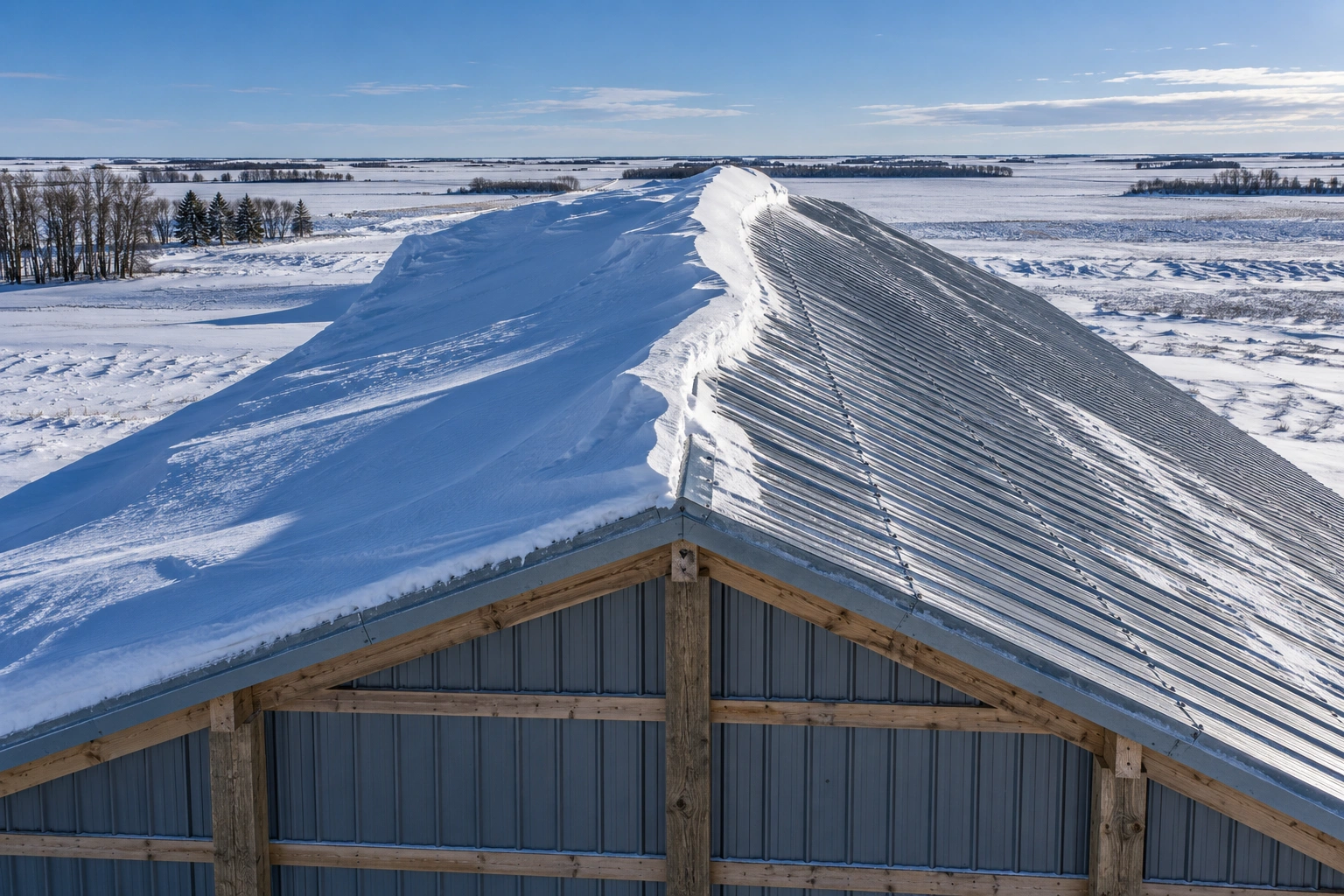 Roof Snow Load in the Red River ValleyGround snow load, roof snow load, drift, and why the figure changes when you cross the river.
 What Actually Drives Post-Frame Cost HereThe decisions that move the price, and where a quote's differences are usually hiding.
Not sure which rules apply to your parcel
Tell us where the site is and we will establish the jurisdiction and the applicable requirements before anything is designed.