Hawley MN Pole Barn Builders | Livestock Barns, Shops & Farm Buildings
Post-frame barns, shops and farm buildings around Hawley, in the rolling eastern part of Clay County along the Buffalo River. More cattle work than anywhere else we operate, and the building type most often ruined by being sealed up for the winter. Fargo ND Pole Barn Builders also builds across the rest of Cass County, North Dakota and Clay County, Minnesota.
Get a quote on your building
Tell us the size, the use and where the site is. We will come back with a scope and a price, not a brochure.
Hawley MN Pole Barn Builders
Buffalo River country, and the Shoreland rules that come with it
Hawley went through six quick name changes after 1871 before settling in 1872 on a name honouring Thomas Hawley Canfield, an officer of the Northern Pacific Railway which laid the town out. It had 2,219 residents at the 2020 census and sits about 23 miles from the Fargo-Moorhead area along the Buffalo River.
The ground here is rolling rather than flat, on the eastern edge of the beach ridge country, and there is more livestock farming than you find on the valley floor. Both of those change the buildings.
Warm is the wrong goal in a cattle building
The instinct every winter is to close a livestock building up so the animals stay warm. Cattle generate plenty of heat and an enormous amount of moisture, and a sealed building traps the moisture with them. It condenses on the underside of the roof steel, drips into the bedding, and turns into respiratory problems by February and rot in the framing over a few years. Dry beats warm, every time, and dry means ventilated all winter.
How we build in Hawley
- Shoreland provisions checked
The Buffalo River brings Clay County's Shoreland district into play within 300 feet.
- Livestock ventilation designed
Air movement calculated against building width and stocking rather than fitted by default.
- Slope worked into the design
Rolling ground means real fall, which helps drainage and complicates pad levelling.
- Clay County loads applied
50 psf ground snow load, 60-inch footings, Minnesota code throughout.
Before a livestock building near Hawley
The regulatory work here runs on a separate track from the building permit.
- Confirm your feedlot position
Animal feeding operations are regulated through the Minnesota system with Clay County operating a County Feedlot Officer. Registration and manure management requirements are separate from your building approval.
- Check Shoreland status against the Buffalo River
Within 300 feet of a river or stream the Shoreland district applies, bringing lot standards, setbacks and impervious surface limits into the siting decision.
- Settle the stocking numbers and class
Cow-calf, backgrounding, finishing and dairy all want different space, pen layouts and ventilation rates. This decides the building more than the dimensions do.
- Decide how manure leaves the building
Scrape, bedded pack or slatted. It determines floor design, door placement, column base protection and whether you need a storage structure alongside.
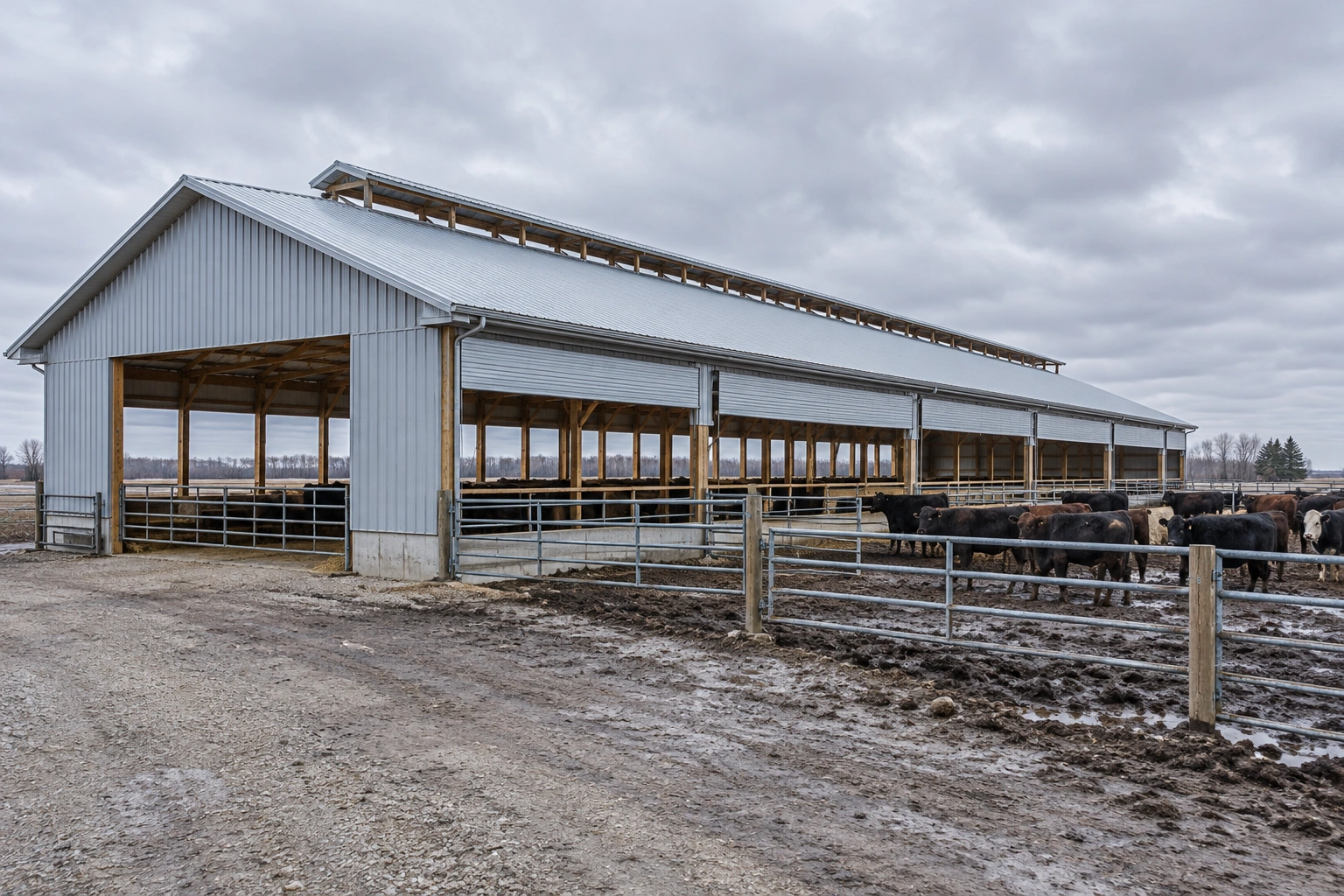
Livestock buildings are a larger share of the work around Hawley than anywhere else we operate, and they are the building type most often got wrong. A livestock barn is a ventilation problem with a roof attached, and the single most common failure is closing the building up in winter to keep the animals warm.
Animals produce enormous amounts of moisture. A sealed barn traps it, it condenses on the underside of the roof steel, and the result is wet bedding, respiratory problems and rot in the framing. The buildings that work here are deliberately ventilated year round.
Local conditions and figures
Clay County operates a County Feedlot Officer as part of the Minnesota feedlot regulatory system, and animal feeding operations have registration and manure management requirements that are entirely separate from your building permit. Getting the building approved does not mean the operation is registered, and both need attention.
The Shoreland district applies within 300 feet of any river or stream, which around Hawley means the Buffalo River corridor. Shoreland brings lot standards, setbacks, impervious surface coverage limits and vegetation clearing rules, all of which affect where a barn can go.
The rolling ground here also changes how snow behaves compared with the flat valley floor. Drifts form against terrain as well as against buildings, and a farmstead tucked into a hollow collects snow differently from one on a rise. That is worth walking before a building position is fixed, because a barn sited in a natural collection point will be dug out every winter for as long as it stands.
What we build around Hawley
More livestock work than anywhere else in our area.
- Cattle and stock buildings
With adjustable sidewall intake, a properly sized ridge outlet, and concrete or heavy timber at animal contact height rather than steel.
- Dairy and calving facilities
Where temperature is actively managed, which changes the insulation and vapour control requirements substantially.
- Hay and bedding storage
Tall open-sided sheds, sited away from buildings you cannot afford to lose.
- Farm shops
Heated and wired, on operations that do their own machinery maintenance.
How a Hawley build runs
- Step 01Siting and regulatory check
Shoreland status, feedlot requirements and zoning district all established before the position is fixed.
- Step 02Ventilation design
On livestock buildings, intake and outlet sized against width and stocking before the layout is finalised.
- Step 03Foundations and frame
Footings to 60 inches with column base protection where manure will sit against them.
- Step 04Wainscot and fit-out
Contact-height wainscot built, then ventilation hardware, gates, waterers and lighting.
Questions we get asked in Hawley
Do you build livestock barns around Hawley?
Yes, and it is a bigger part of our work here than anywhere else. Livestock buildings need a different approach: ventilation designed first, concrete or heavy timber at animal contact height, and column bases protected from the bedded pack.
Do cattle barns around Hawley need insulating?
For most beef operations, no. Cattle tolerate cold far better than damp, and an uninsulated well-ventilated building stays drier. Insulation belongs in calving barns and dairy facilities where temperature is actively managed, and then it needs proper vapour control.
Do Shoreland rules apply near the Buffalo River?
Within 300 feet of a river or stream, yes. Clay County's Shoreland district brings lot standards, setbacks, impervious surface limits and vegetation clearing rules. Worth checking with Clay County Planning before choosing a barn site.
Is feedlot registration the same as a building permit?
No, and this catches people out. Animal feeding operations are regulated separately through the Minnesota system with Clay County operating a County Feedlot Officer. Getting your building permit does not register the operation.
What snow load applies on the Minnesota side here?
50 psf ground snow load, as throughout Clay County under Minnesota Rules 1303.1700, with drift cases checked on any building with a step in the roof line.
Do you charge for a visit to a Hawley farm?
No. For livestock work the visit is genuinely important, because the existing handling setup usually dictates the layout more than the site does.
How many animals can I keep before extra rules apply?
Thresholds in the Minnesota feedlot system are based on animal units rather than head count, and they determine registration and manure management requirements separately from your building permit. Clay County operates a County Feedlot Officer who can tell you exactly where your operation sits. It is worth establishing before you commit to a building size, not after.
Does my barn permit cover the manure storage as well?
No. The building permit covers the structure. Manure management and feedlot registration run through the Minnesota feedlot system, with Clay County operating a County Feedlot Officer, and the thresholds are based on animal units rather than head count. Both processes need to be started before you commit to a site, and the feedlot one is frequently the slower of the two.
Everything we build in Hawley
All of these are available around Hawley. Livestock housing is the larger share of the work locally, and everything else on the list is built here too.
- Agricultural Pole Barns
- Horse Barns & Equestrian Buildings
- Machine Sheds & Equipment Storage
- Livestock Barns
- Hay Storage Buildings
- Pole Barn Garages
- RV & Boat Storage Pole Barns
- Pole Barn Workshops
- Commercial Pole Barns
- Hobby Shops & Man Cave Pole Barns
- Pole Barn Construction
- Pole Barn Design & Planning
- Pole Barn Foundation & Concrete Work
- Pole Barn Framing
- Pole Barn Roofing Installation
- Pole Barn Siding Installation
- Pole Barn Electrical Rough-In
- Pole Barn Insulation Installation
- Pole Barn Repair
- Pole Barn Renovation & Additions
- Post-Frame Building Construction
- Insulated Pole Barns
- Pole Barns with Living Quarters (Barndominiums)
- Custom Pole Barn Doors & Windows
- Pole Barn Loft & Second-Story Additions
- Metal Roof Pole Barns
- Wood-Sided Pole Barns
- Pole Barn Ventilation Systems
- Pole Barn Site Prep & Grading
- Pole Barn Snow Load Reinforcement
Barns and farm buildings around Hawley
Tell us the class of animal, the numbers and how manure leaves the building. That gets us most of the way to a design.