Dilworth MN Pole Barn Builders | Garages, Shops & Storage Buildings
Post-frame buildings in Dilworth and the surrounding Clay County townships, designed to Minnesota loads and the county's permitting process. Railroad-era plats are tighter than people expect, so the lot dimensions usually decide the building size before your preferences do. Fargo ND Pole Barn Builders also builds across the rest of Cass County, North Dakota and Clay County, Minnesota.
Get a quote on your building
Tell us the size, the use and where the site is. We will come back with a scope and a price, not a brochure.
Dilworth MN Pole Barn Builders
A railroad town with the lot sizes to prove it
Dilworth began in 1883 as a Northern Pacific railroad siding, briefly called Richardson before being renamed for Joseph Dilworth, a Pittsburgh coffee importer and Northern Pacific director who had bought four thousand acres in the area. The townsite was platted in 1906, the post office opened in 1907, and the village incorporated in 1911.
That history shows up in the lot layout. Railroad towns were platted tight and practical, and Dilworth's older residential streets have smaller lots and narrower setbacks than anything built in the last forty years. It is the main constraint on what can be built behind an existing house here.
How we build in Dilworth
- Lot dimensions confirmed before design
Older platted lots here are frequently tighter than people assume, and setbacks bite quickly.
- Clay County snow load applied
50 psf under Minnesota Rules 1303.1700, higher than the Cass County figure across the river.
- Urban Expansion district considered
Clay County's Urban Expansion Tiers extend roughly two miles around Dilworth as well as Moorhead.
- Rail corridor proximity noted
The BNSF yard here is substantial and parcels near it have their own access and noise considerations.
Building near the rail yard
The BNSF facility here is one of the largest in Minnesota and it shapes the parcels around it. For commercial and storage buildings that is mostly an advantage, with good access and established industrial neighbours. What it does affect is approach routing for deliveries and, on some parcels, which side of the site heavy vehicles can realistically reach. We check the approach before we commit to a door orientation.
Local conditions and figures
Dilworth sits on the eastern edge of Moorhead on the same flat lakebed ground, and the water table and drainage questions are identical to the rest of the valley floor. Building pads are raised, drainage routes are established, and nothing is assumed to shed on its own.
The town was once called Little Italy for the large Italian immigrant community that settled around the railway, and the older housing stock reflects that period of construction. On properties from that era, matching a new building to the house is more about proportion and roof pitch than about materials.
Because so much of the housing here dates from the railway era, a new detached building frequently sits next to a house with a shallower roof pitch and smaller proportions than anything built recently. Matching a modern 30 by 40 garage to a 1950s bungalow is more about getting the pitch and the eave height sympathetic than about matching the siding colour. It is worth a conversation at design stage rather than a surprise at handover.
Worth sorting out before design in Dilworth
Older platted lots create constraints that newer subdivisions do not.
- Measure the lot yourself
Railroad-era plats are tighter than people expect, and the difference between what you want and what the setbacks allow is usually discovered at the tape rather than on paper.
- Check the alley access
Many Dilworth properties are served from a rear alley, which decides where the door goes and whether a vehicle can actually turn into the building once it is built.
- Confirm the existing garage's status
Replacing a non-conforming older structure is a different conversation from adding a new one, and the city will treat the two differently.
- Ask about the Urban Expansion tiers
They extend around Dilworth as well as Moorhead, so a parcel just outside the city may still carry additional provisions.
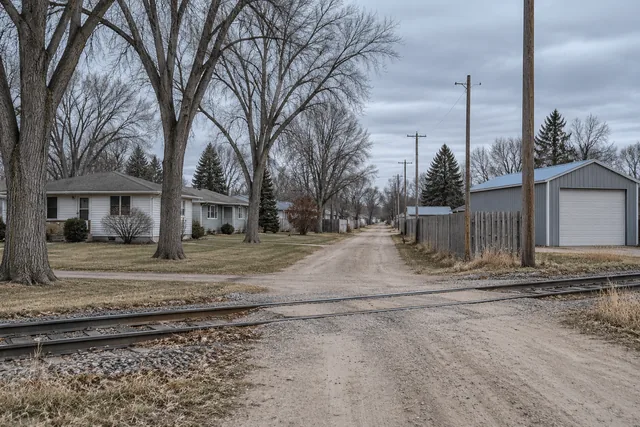
Dilworth is home to the BNSF Dilworth Rail Yard, one of the railway's largest and busiest facilities in Minnesota, and the town's character still reflects that. For building work it means two things: a significant employer with commercial and light industrial activity around it, and residential streets laid out in an era when a detached garage meant something much smaller than people want now.
On the town's edges and in the surrounding townships, the constraint disappears entirely and you are on open Clay County agricultural ground with the usual valley considerations about drainage and pad height.
What we build around Dilworth
The mix here is different from the Fargo side.
- Replacement garages on older lots
Working within tight setbacks and older alley access, frequently replacing a single-bay garage from the fifties with something that will actually hold a modern vehicle.
- Light commercial and contractor buildings
The rail corridor and the highway access make Dilworth reasonable for trade and storage buildings, permitted to the commercial code rather than as accessory structures.
- Agricultural buildings in the townships
Once you leave the city, Clay County is overwhelmingly zoned Agricultural General and normal farm building work applies.
- Storage for seasonal vehicles
Campers, boats and collector vehicles, where the alternative is an outdoor lot and a winter of weather.
How a Dilworth build runs
- Step 01Confirm lot and jurisdiction
City or county, lot dimensions and setbacks, and whether the Urban Expansion district applies.
- Step 02Design to Clay County loads
50 psf ground snow load with drift cases checked, and energy compliance where heated.
- Step 03Permit
Through the city inside the boundary, or Clay County Planning outside it.
- Step 04Build
Footings to 60 inches, frame, envelope and finish, with inspections through the process.
Questions we get asked in Dilworth
Do I need a permit to build a garage in Dilworth?
Yes. Minnesota's State Building Code is mandatory statewide, so every jurisdiction enforces it. Inside city limits the city permits and inspects; outside, Clay County Planning handles it.
Will a pole barn fit on my lot?
Often, but Dilworth's older platted lots are tighter than newer subdivisions and setbacks can be the limiting factor rather than your preference. It is worth establishing the actual lot dimensions and setbacks before settling on a size.
What snow load applies in Dilworth?
Clay County's ground snow load is 50 psf under Minnesota Rules 1303.1700. That is higher than the 40 psf that applies in Cass County across the river, and the structure is designed accordingly.
Can you build on the acreages outside town?
Yes, and a good share of our Clay County work is in the surrounding townships. Over 90 percent of the county is zoned Agricultural General, which generally gives more scope than a town lot does.
How long does a build take?
A straightforward shell goes up in a week or two of working weather. Ground conditions, concrete curing and inspections extend it. Spring is the slow season here, not because of cold but because saturated clay will not carry a loaded truck.
Do you charge for quotes in Dilworth?
No. Quotes and site visits are free.
Can you work from an alley rather than the street?
Usually yes, and on Dilworth's older blocks it is often the only sensible approach. What we check first is whether the alley surface will carry a loaded ready-mix truck and whether there is room to turn at the end of it. Where it will not, we plan the pour around a pump or a different access point rather than finding out on the day.
Does Dilworth issue its own permits or does the county?
The city does. Clay County is explicit that building permits for cities within the county are issued through the city halls rather than through the Planning Office, which only handles rural areas. That matters here because the Urban Expansion district extends roughly two miles beyond the boundary, so a nearby parcel can sit under county jurisdiction with additional provisions.
Everything we build in Dilworth
Every one of these is available in Dilworth. On the older platted lots the limiting factor is usually the setbacks rather than the service list, which is why we check the lot before we talk about size.
- Agricultural Pole Barns
- Horse Barns & Equestrian Buildings
- Machine Sheds & Equipment Storage
- Livestock Barns
- Hay Storage Buildings
- Pole Barn Garages
- RV & Boat Storage Pole Barns
- Pole Barn Workshops
- Commercial Pole Barns
- Hobby Shops & Man Cave Pole Barns
- Pole Barn Construction
- Pole Barn Design & Planning
- Pole Barn Foundation & Concrete Work
- Pole Barn Framing
- Pole Barn Roofing Installation
- Pole Barn Siding Installation
- Pole Barn Electrical Rough-In
- Pole Barn Insulation Installation
- Pole Barn Repair
- Pole Barn Renovation & Additions
- Post-Frame Building Construction
- Insulated Pole Barns
- Pole Barns with Living Quarters (Barndominiums)
- Custom Pole Barn Doors & Windows
- Pole Barn Loft & Second-Story Additions
- Metal Roof Pole Barns
- Wood-Sided Pole Barns
- Pole Barn Ventilation Systems
- Pole Barn Site Prep & Grading
- Pole Barn Snow Load Reinforcement
Building in Dilworth
Send us the lot details or the parcel and we will check what will actually fit before designing anything.