Buffalo ND Pole Barn Builders | Farm Buildings & Snow Load Reinforcement
Post-frame farm buildings, repairs and snow load reinforcement around Buffalo in western Cass County. Interstate frontage makes access easy, and the open farmland behind it makes drift the load that decides whether an older roof survives the winter. Fargo ND Pole Barn Builders also builds across the rest of Cass County, North Dakota and Clay County, Minnesota.
Get a quote on your building
Tell us the size, the use and where the site is. We will come back with a scope and a price, not a brochure.
Buffalo ND Pole Barn Builders
Western Cass County, on the interstate and fully exposed
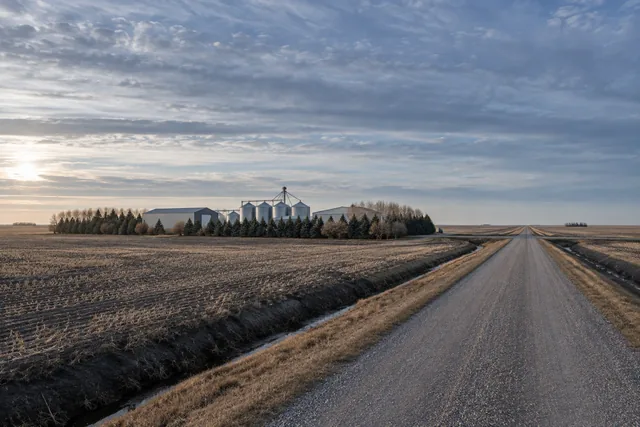
Buffalo is a small city in western Cass County on the Interstate 94 corridor, surrounded by open farmland. The highway makes access and material delivery straightforward, which is genuinely useful in a part of the county where gravel section roads otherwise set the limits in spring.
The exposure here is complete, and the work reflects it: large farm buildings, and an ongoing amount of reinforcement on older ones that were designed to different standards or extended without anyone calculating the drift.
Local conditions and figures
Western Cass County is flat open farmland with the same Lake Agassiz clay as the rest of the county, though the ground rises very slightly toward the western county line. The drainage picture is unchanged: pads raised, routes established, nothing assumed to shed on its own.
Interstate access means material and concrete reach sites here reliably, which is worth more than it sounds. On the gravel-road parts of the county, spring access frequently sets the programme rather than the weather.
Interstate access also means this is one of the few parts of rural Cass County where a spring build is sometimes genuinely feasible, because the approach from the highway is short and hard-surfaced for most of its length. That is worth knowing if a building is needed before harvest. It is the exception locally rather than the rule, and it depends entirely on the last few hundred yards onto the parcel.
Why the lean-to fails and the main roof does not
We are called to far more lean-tos and additions than main roofs, and the reason is consistent. The main building was designed for its loads by someone who did the calculation. The lower roof was added ten or twenty years later, often by a different crew, and the drift case for the step between them was never worked out. It has been collecting several times the balanced load in that corner every winter since, and eventually a heavy year finds the limit.
How we build in Buffalo
- Drift calculated, not estimated
It is the load that governs on lean-tos, additions and lower roofs beside taller ones.
- Exposure C wind design
Open farmland in every direction, with the design pressures that follow.
- Older buildings assessed honestly
Including whether reinforcement or replacement is the better use of your money.
- Good highway access used
Delivery and ready-mix scheduling benefit from the interstate, which shortens programmes.
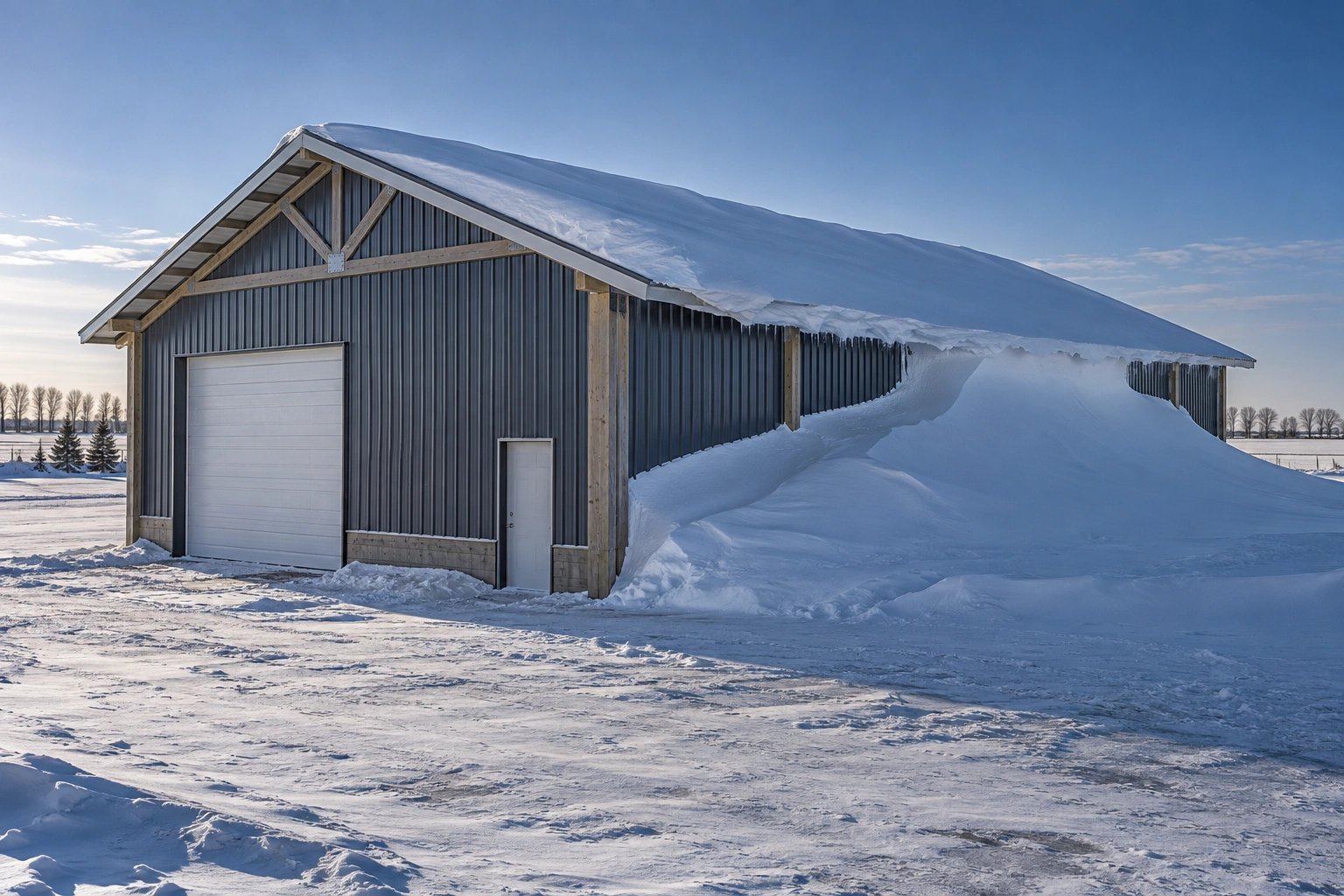
Uniform snow rarely brings a roof down on its own. What does it is drift: wind-driven snow moving across open prairie until it hits an obstruction and piles up. In a step between two roofs, or against a taller wall, the accumulated load can be three or four times the ground snow figure.
That is why so many of the failures we look at are on lean-tos and additions rather than on main roofs. The main building is fine. The bit next to it is carrying a load nobody calculated when it went up.
If you are worried about a roof near Buffalo
Four things to do before the snow arrives, in this order.
- Sight along the ridge from the gable end
In good light, from outside. A dip you can see is a deflection that will not reverse itself when the snow melts.
- Look at the purlins from inside
Bowing between trusses, splits developing at knots, or fasteners starting to pull are all overload indicators worth acting on.
- Note where the drift banks up
Which wall, how deep, and whether there is a step in the roof line above it. That usually identifies the problem before we arrive.
- Do not get on the roof
Uneven snow removal creates unbalanced loading that can be worse than what you started with, and a metal roof in winter is a genuinely dangerous place to be.
Why older buildings around here are struggling
Four reasons we get called out.
- Designed to older standards
Buildings from the sixties and seventies were designed to different load requirements with different connection hardware, and some of them are now marginal.
- Extended without drift calculation
A lean-to added in the eighties beside a taller main roof has been collecting drift every winter since, and nobody ever calculated it.
- Purlins laid flat
A common shortcut on older buildings that costs most of the roof's stiffness, which shows up as deflection under snow.
- Column bases gone at grade
Fifty years of oxygen, moisture and timber at the air-soil interface. It is the classic failure and it is entirely repairable.
How a Buffalo job runs
- Step 01Inspect and measure
For reinforcement work, deflection measured, members recorded and connections assessed.
- Step 02Calculate
Existing capacity established and required capacity calculated including drift and unbalanced cases.
- Step 03Design the fix
Members sized against the calculated shortfall, with the whole load path rechecked down to the footings.
- Step 04Install
With temporary support where needed, and the building left with a documented capacity.
Questions we get asked in Buffalo
How do I know if my roof needs reinforcement?
Sight along the ridge from the gable end. A visible dip means deflection. Other signs are purlins bowing between trusses, cracked truss chords, fasteners pulling at the roof, and doors that have started binding after heavy snowfalls.
Why do lean-tos fail more often than main roofs?
Drift. Wind-driven snow moving across open prairie piles up against any obstruction, and a lower roof beside a taller wall is the classic trap. The load in that drift zone can be three or four times the balanced roof load, and the lean-to was rarely designed for it.
Should I shovel the roof?
Only with advice, and rarely yourself. Removing snow unevenly creates unbalanced loading that can be worse than what you started with, and metal roofs in winter are extremely dangerous. If you are worried enough to consider it, call someone to look at the structure instead.
Can a building from the seventies be brought up to current loads?
Frequently yes. Where the timber is sound, sistering members, upgrading connections and adding purlins costs far less than replacement. Where multiple members are damaged or decayed, the arithmetic changes and we will tell you.
What snow load applies in western Cass County?
40 psf ground snow load for Cass County under the state table, with roof snow, drift and unbalanced cases calculated from it under ASCE 7.
Do you charge to assess a roof near Buffalo?
No. Assessment and quotation are free, and if a building looks genuinely unsafe we will tell you on the spot rather than waiting to write it up.
How quickly can you come out if the roof is worrying us?
If a roof is visibly deflecting under snow, making noise or has fasteners pulling, treat it as urgent and tell us that when you call. That is the one situation where we will move other work. In the meantime the advice is to clear the building and stay out of it, and not to climb up and start shovelling.
Is there a permit issue with reinforcing an old roof?
Structural alteration generally requires one, and it is worth having. A permitted and engineered reinforcement leaves a documented capacity attached to the building, which is exactly what an insurer or a buyer will ask about after a heavy winter. Around Buffalo a good share of the roofs needing work were extended decades ago without a drift calculation.
Everything we build in Buffalo
Everything here is available around Buffalo. Interstate access makes deliveries straightforward, which occasionally makes a spring start feasible when it would not be elsewhere in the county.
- Agricultural Pole Barns
- Horse Barns & Equestrian Buildings
- Machine Sheds & Equipment Storage
- Livestock Barns
- Hay Storage Buildings
- Pole Barn Garages
- RV & Boat Storage Pole Barns
- Pole Barn Workshops
- Commercial Pole Barns
- Hobby Shops & Man Cave Pole Barns
- Pole Barn Construction
- Pole Barn Design & Planning
- Pole Barn Foundation & Concrete Work
- Pole Barn Framing
- Pole Barn Roofing Installation
- Pole Barn Siding Installation
- Pole Barn Electrical Rough-In
- Pole Barn Insulation Installation
- Pole Barn Repair
- Pole Barn Renovation & Additions
- Post-Frame Building Construction
- Insulated Pole Barns
- Pole Barns with Living Quarters (Barndominiums)
- Custom Pole Barn Doors & Windows
- Pole Barn Loft & Second-Story Additions
- Metal Roof Pole Barns
- Wood-Sided Pole Barns
- Pole Barn Ventilation Systems
- Pole Barn Site Prep & Grading
- Pole Barn Snow Load Reinforcement
Worried about a roof near Buffalo
Tell us what you are seeing and roughly how old the building is. We will come and measure rather than guess from a photo.