Kindred ND Pole Barn Builders | Horse Barns, Arenas & Acreage Shops
Post-frame barns, shops and farm buildings around Kindred, in the Sheyenne River valley where the ground finally does something other than lie flat. The Sheyenne valley is the one part of Cass County with real fall to it, and that makes drainage design a great deal easier than on the valley floor. Fargo ND Pole Barn Builders also builds across the rest of Cass County, North Dakota and Clay County, Minnesota.
Get a quote on your building
Tell us the size, the use and where the site is. We will come back with a scope and a price, not a brochure.
Kindred ND Pole Barn Builders
The one part of Cass County with actual terrain
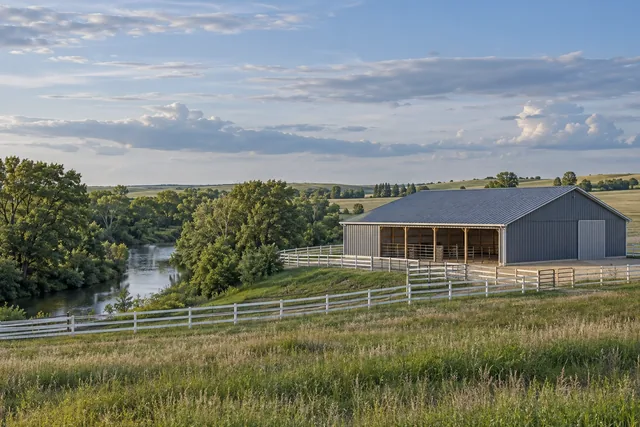
Kindred sits on the Sheyenne River in southern Cass County, with 889 residents at the 2020 census. The Sheyenne crosses the county diagonally from the southwest before joining the Red near West Fargo, and it creates the only meaningful topography in an otherwise dead-flat county.
That river valley changes what we build here. There are more horse properties and small acreages around Kindred than in most of the county, and the drainage situation is genuinely different from the valley floor.
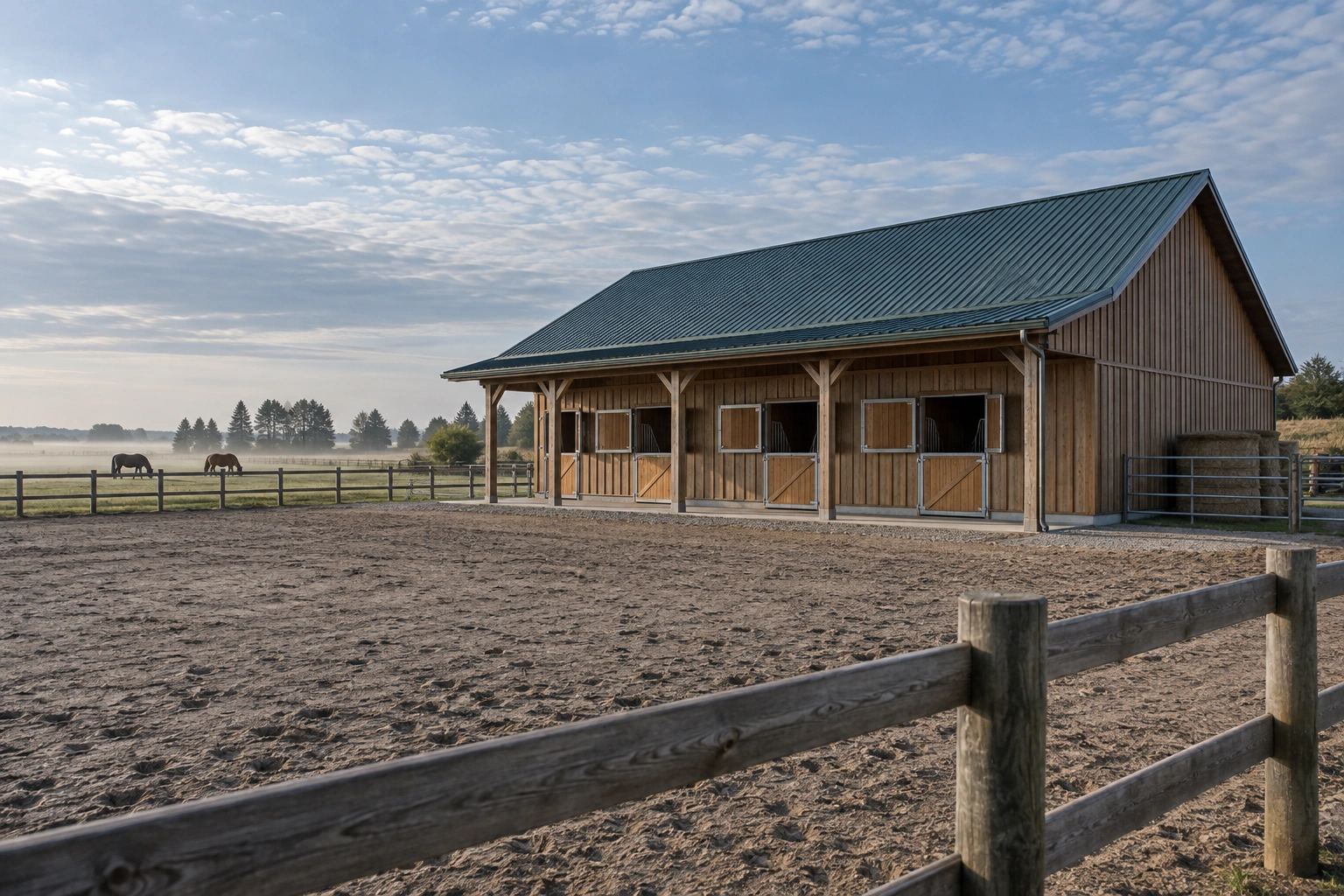
The Sheyenne valley is a pleasant place to keep horses, which is why so many of the equestrian properties in Cass County are here. What that means for us is that a large share of the Kindred work is barns rather than machine sheds, and barns are a different discipline.
Stall layouts, aisle widths, kickboard detailing and above all ventilation are what make or break an equestrian building, and none of them are things a general shed builder thinks about.
Local conditions and figures
Building near a river brings requirements that a flat field does not. Cass County township zoning ordinances set watercourse setbacks with defined disturbance zones, and Cass County Planning handles floodplain administration for jurisdictions that are not in the National Flood Insurance Program. On a parcel within sight of the Sheyenne, those are the first checks.
The compensation is that ground near the valley frequently has some fall to it, which makes drainage design considerably easier than on the valley floor. It is the one place in the county where water will actually go somewhere if you point it in the right direction.
Equestrian work also tends to arrive in phases, which is worth planning for rather than reacting to. A barn goes up first, an arena follows two or three years later, and hay storage arrives when somebody gets tired of paying for it elsewhere. Siting all three at the start costs nothing and avoids the most common outcome, which is three buildings arranged so that two of them create a drift onto the third.
How we build in Kindred
- Shoreland and watercourse setbacks checked
River proximity brings setback requirements through the township ordinance and county floodplain administration.
- Slope used rather than fought
Where there is actual fall, drainage becomes easier. That is worth designing around rather than ignoring.
- Equestrian ventilation designed properly
Horse buildings are ventilation problems first, and the strategy comes before the layout.
- Bank stability considered
Building near a river bank raises questions that flat-field sites do not.
What Kindred properties ask for
A different mix from the rest of the county.
- Horse barns
Stalls, aisle, tack and feed, with ventilation designed first rather than added. Frequently with an arena planned for a later phase.
- Riding arenas
Clear-span structures considerably wider than a barn, which changes the truss design and the bracing substantially.
- Acreage shops
Heated buildings for people with land but not a farming operation, wired and insulated for year-round use.
- Hay and bedding storage
Separate from the barn, ideally, because stored forage next to a building you cannot afford to lose is an avoidable risk.
How a Kindred build runs
- Step 01Siting and setbacks
Position established with watercourse setbacks, floodplain and bank stability all considered.
- Step 02Ventilation and layout
On equestrian buildings, the air movement strategy is designed before the stall layout.
- Step 03Foundations and frame
Footings to 60 inches, columns set, and the frame erected and roofed.
- Step 04Fit-out
Stall fronts, kickboard, hydrants, lighting and doors, in an order that avoids damaging finished work.
Before designing an equestrian building near Kindred
Horse buildings reward planning more than almost any other type.
- Decide the honest stall count
Not today's number, the number in five years. Adding a stall to a designed bay is straightforward; extending a barn that was framed to length is not.
- Work out the muck route
Where manure leaves the building drives door placement, and the storage location has to respect watercourse setbacks if you are near the Sheyenne.
- Say now if an arena is coming
An arena is a much wider span with different truss and bracing design. Planning both together, even if you build them years apart, avoids creating a drift step between them.
- Confirm the water supply and its freeze protection
Frost-free hydrants, buried line depth and where spillage drains all have to be settled before the slab, not after.
The one part of Cass County where drainage helps you
Ground near the Sheyenne valley generally has some genuine fall to it, which is unusual here and worth using. On the valley floor we are creating drainage from nothing by building the pad up and cutting a route out. Around Kindred there is often somewhere for water to go already, which means a lower pad, less imported fill and a smaller site preparation line in the quote. It is the one place locally where the ground is on your side.
Questions we get asked in Kindred
Do you build horse barns around Kindred?
Yes, and it is a significant part of our work in this area. The Sheyenne valley has more equestrian properties than the rest of Cass County, and horse buildings need a different approach from machine sheds, particularly on ventilation.
Are there restrictions building near the Sheyenne River?
Yes. Township zoning ordinances in Cass County set watercourse setbacks with minimal and limited disturbance zones, and Cass County Planning handles floodplain administration for jurisdictions outside the NFIP. Both get checked before siting.
Can you build a riding arena?
Yes, as a clear-span post-frame structure. An arena is a much wider span than a barn, so the truss design, bracing and columns step up considerably. It is worth designing the barn and arena together even if they are built in separate years.
Does a horse barn need to be insulated?
Usually not, and often it is better not to be. Horses handle cold well and damp badly. A well-ventilated uninsulated barn stays drier. Heated tack rooms and wash bays are built as insulated boxes inside the larger structure.
Is the drainage better here than on the valley floor?
Generally yes, which is a rare thing to be able to say in Cass County. Ground near the Sheyenne valley usually has some fall, so water will actually move if you direct it. Pads still get built up, but the design is less of a fight.
Is there a charge for looking at a Kindred property?
No. Quotes and site visits are free, and on equestrian work the visit matters because paddock access, prevailing wind and the muck route all affect where the barn should sit.
How close to the Sheyenne can I build?
That is set by the township's watercourse setback rather than by a single county-wide figure, and the ordinances commonly define minimal and limited disturbance zones either side of the channel. Cass County Planning can point you at the right document for your township. We would check it before siting rather than designing around a guess.
How do watercourse setbacks affect a permit near the Sheyenne?
They are set by the township ordinance rather than by a single county-wide figure, and the ordinances commonly define minimal and limited disturbance zones either side of the channel within which building is constrained. It is a zoning question rather than a building code one, which means the agricultural exemption does nothing for you here.
Everything we build in Kindred
All of these are available around Kindred. The equestrian work is what the area is known for, and the rest of the list runs alongside it rather than instead of it.
- Agricultural Pole Barns
- Horse Barns & Equestrian Buildings
- Machine Sheds & Equipment Storage
- Livestock Barns
- Hay Storage Buildings
- Pole Barn Garages
- RV & Boat Storage Pole Barns
- Pole Barn Workshops
- Commercial Pole Barns
- Hobby Shops & Man Cave Pole Barns
- Pole Barn Construction
- Pole Barn Design & Planning
- Pole Barn Foundation & Concrete Work
- Pole Barn Framing
- Pole Barn Roofing Installation
- Pole Barn Siding Installation
- Pole Barn Electrical Rough-In
- Pole Barn Insulation Installation
- Pole Barn Repair
- Pole Barn Renovation & Additions
- Post-Frame Building Construction
- Insulated Pole Barns
- Pole Barns with Living Quarters (Barndominiums)
- Custom Pole Barn Doors & Windows
- Pole Barn Loft & Second-Story Additions
- Metal Roof Pole Barns
- Wood-Sided Pole Barns
- Pole Barn Ventilation Systems
- Pole Barn Site Prep & Grading
- Pole Barn Snow Load Reinforcement
Barns and shops around Kindred
Tell us the number of stalls, whether an arena is coming, and where the paddocks are. We will work the layout from there.