Georgetown MN Pole Barn Builders | Post-Frame Buildings on Northern Clay County Bottomland
Post-frame buildings in Georgetown and northern Clay County, on Red River bottomland where the pad height is the most important decision. Some of the lowest ground we build on, where the regulatory flood protection elevation decides how much fill goes under the building. Fargo ND Pole Barn Builders also builds across the rest of Cass County, North Dakota and Clay County, Minnesota.
Get a quote on your building
Tell us the size, the use and where the site is. We will come back with a scope and a price, not a brochure.
Georgetown MN Pole Barn Builders
One of the oldest settlements in the valley, on the lowest ground
Georgetown is one of the older settlements in the Red River Valley, in northern Clay County near where the Buffalo River meets the Red. It is a small community, and the surrounding Georgetown Township is agricultural ground on the valley bottom.
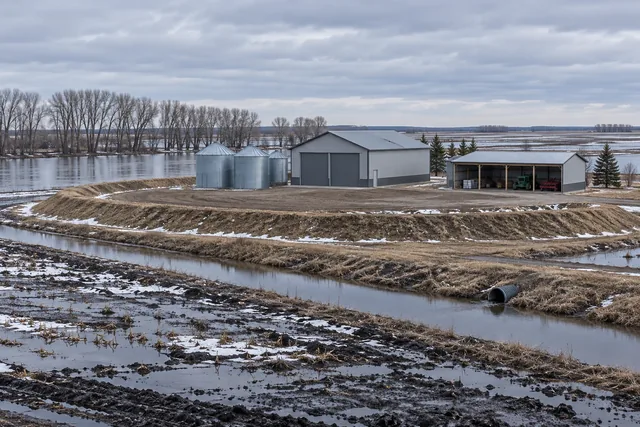
It is also some of the lowest ground we build on. Everything we do here is shaped by the fact that the Red River flows north, thaws at the wrong end first, and backs water up across land with essentially no fall.
Local conditions and figures
Rural Clay County building permits go through the county Planning Office, and Shoreland provisions apply within 300 feet of a river or stream. Georgetown's position near the Buffalo and Red confluence means Shoreland status is worth checking on almost any parcel here rather than assumed away.
Clay County also requires a minimum three-foot horizontal separation between the farthest exterior projection of a building and a well, and requires septic certification where a building permit applicant is in the Shoreland district or is adding bedrooms. On rural bottomland parcels both come up regularly.
Access on bottomland parcels is frequently the binding constraint rather than the building itself. A single soft approach lane can put a site out of reach for a loaded ready-mix truck for six weeks in spring, regardless of how dry the building pad is. Where the approach is marginal, building up the lane as part of the site work is usually money better spent than almost anything else in the quote.
Building on the lowest ground in the valley
Four things we do differently here.
- Build the pad higher
Substantially higher than we would anywhere else. It is the cheapest insurance available and it cannot be added once the building is up.
- Keep timber out of the water
Precast concrete column bases or steel bracket systems carry the load from below grade to a timber column starting above the flood line.
- Design for the water to leave
Not just to arrive somewhere else. The drainage route has to go all the way to somewhere water can actually go.
- Schedule realistically
Late summer and autumn are the reliable windows. Winter frequently beats spring on bottomland, because frozen ground carries trucks and saturated clay does not.
How we build in Georgetown
- Pad height as the primary decision
On this ground, how high you build the pad matters more than anything else about the building.
- Floodplain position established first
Before siting, not after, and with the county's floodproofing requirements understood.
- Column bases protected
Precast concrete bases or steel brackets where a site floods periodically, keeping timber out of the water.
- Access scheduled around the thaw
Saturated bottomland clay will not carry a loaded truck, and no amount of planning changes that.
Clay County's development code requires that within any flood plain zone, a proposed use must be elevated on fill or floodproofed to the regulatory flood protection elevation. On bottomland near the Red and the Buffalo, that is not an abstract provision. It is the thing that determines how much fill goes under a building.
The good news is that post-frame construction handles this well. Isolated footings, a raised granular pad and a floating slab is a resilient arrangement on ground that moves and wets seasonally.
How a Georgetown build runs
- Step 01Flood and water assessment
Floodplain position, regulatory flood protection elevation and the site's actual spring behaviour established.
- Step 02Pad design
Fill volume and height calculated against that, with the drainage route taken all the way out.
- Step 03Foundations
Footings to 60 inches with bearing checked, and column base protection specified where flooding is periodic.
- Step 04Frame and finish
Frame, roof steel and walls, then the slab poured inside the finished shell where it can cure out of the weather.
Before building on Georgetown bottomland
On the lowest ground we work, the sequence matters.
- Get the regulatory flood protection elevation
Within a flood plain zone, Clay County's code requires the use to be elevated on fill or floodproofed to that elevation. It is the number that determines how much fill goes under the building.
- Confirm Shoreland status
Near the Buffalo and Red confluence this applies to more parcels than people assume, and it brings its own setbacks and coverage limits.
- Locate the well
Clay County requires three feet of horizontal separation from the farthest exterior projection of the building, which constrains siting on older rural parcels more often than expected.
- Plan the build for late summer or winter
Frozen ground carries trucks. Saturated bottomland clay between thaw and dry-out does not, whatever the calendar says.
Post-frame is the right system for ground that moves
Isolated footings taken below the frost line, a raised granular pad and a slab that floats independently inside the structure is a resilient arrangement on ground that wets and moves seasonally. A slab cast integrally with continuous foundation walls has nowhere to go when the clay swells. Where flooding is genuinely periodic, precast concrete column bases take the timber out of the water entirely, which is the one upgrade we would push hardest for here.
Questions we get asked in Georgetown
Is Georgetown in a floodplain?
Parts of the area are, and it varies by parcel. We establish the floodplain position and the regulatory flood protection elevation with Clay County before siting, because within a flood plain zone the code requires the use to be elevated on fill or floodproofed to that elevation.
How high does the building pad need to be?
Higher than almost anywhere else we work. The figure comes from the site levels and, where the parcel is in a flood plain zone, from the regulatory flood protection elevation. This is the single most important number on the whole job.
Can post-frame construction handle ground like this?
It handles it better than most alternatives. Isolated footings taken below frost, a raised granular pad and a floating slab is a resilient arrangement on ground that wets and moves seasonally. Where flooding is periodic, precast column bases keep timber out of the water entirely.
When in the year can you build on this ground?
Late summer and autumn reliably. Winter is often better than spring, because frozen ground carries trucks. Between thaw and the ground drying, saturated bottomland clay will not carry ready-mix, and that is a physical fact rather than a scheduling preference.
Who issues the permit?
Clay County Planning handles permitting in rural areas, and Shoreland provisions apply within 300 feet of a river or stream. Given the location, Shoreland status is worth checking on most parcels here.
Is a Georgetown site visit chargeable?
Yes. On bottomland sites the visit is essential rather than optional, because what you know about where water goes is the most important input to the design.
Is it worth building here at all given the flood risk?
Frequently yes, and the answer is about siting and pad height rather than about avoiding the area. Post-frame construction copes with this ground better than most alternatives, and a building elevated to the regulatory flood protection elevation on a properly built pad is a sound long-term proposition. Where a parcel genuinely does not work, we would tell you that instead.
What does the flood plain zone require of the permit here?
Clay County's code requires that within a flood plain zone a proposed use is elevated on fill or floodproofed to the regulatory flood protection elevation. On northern Clay County bottomland that single figure determines how much fill goes under the building, so we establish it before siting rather than designing a pad and checking afterwards.
Everything we build in Georgetown
Every service is available in Georgetown and the northern Clay County townships. On this ground the pad design changes considerably; the building types do not.
- Agricultural Pole Barns
- Horse Barns & Equestrian Buildings
- Machine Sheds & Equipment Storage
- Livestock Barns
- Hay Storage Buildings
- Pole Barn Garages
- RV & Boat Storage Pole Barns
- Pole Barn Workshops
- Commercial Pole Barns
- Hobby Shops & Man Cave Pole Barns
- Pole Barn Construction
- Pole Barn Design & Planning
- Pole Barn Foundation & Concrete Work
- Pole Barn Framing
- Pole Barn Roofing Installation
- Pole Barn Siding Installation
- Pole Barn Electrical Rough-In
- Pole Barn Insulation Installation
- Pole Barn Repair
- Pole Barn Renovation & Additions
- Post-Frame Building Construction
- Insulated Pole Barns
- Pole Barns with Living Quarters (Barndominiums)
- Custom Pole Barn Doors & Windows
- Pole Barn Loft & Second-Story Additions
- Metal Roof Pole Barns
- Wood-Sided Pole Barns
- Pole Barn Ventilation Systems
- Pole Barn Site Prep & Grading
- Pole Barn Snow Load Reinforcement
Building on Georgetown bottomland
Tell us the parcel and what the site does in spring. We will establish the floodplain position before designing anything.